
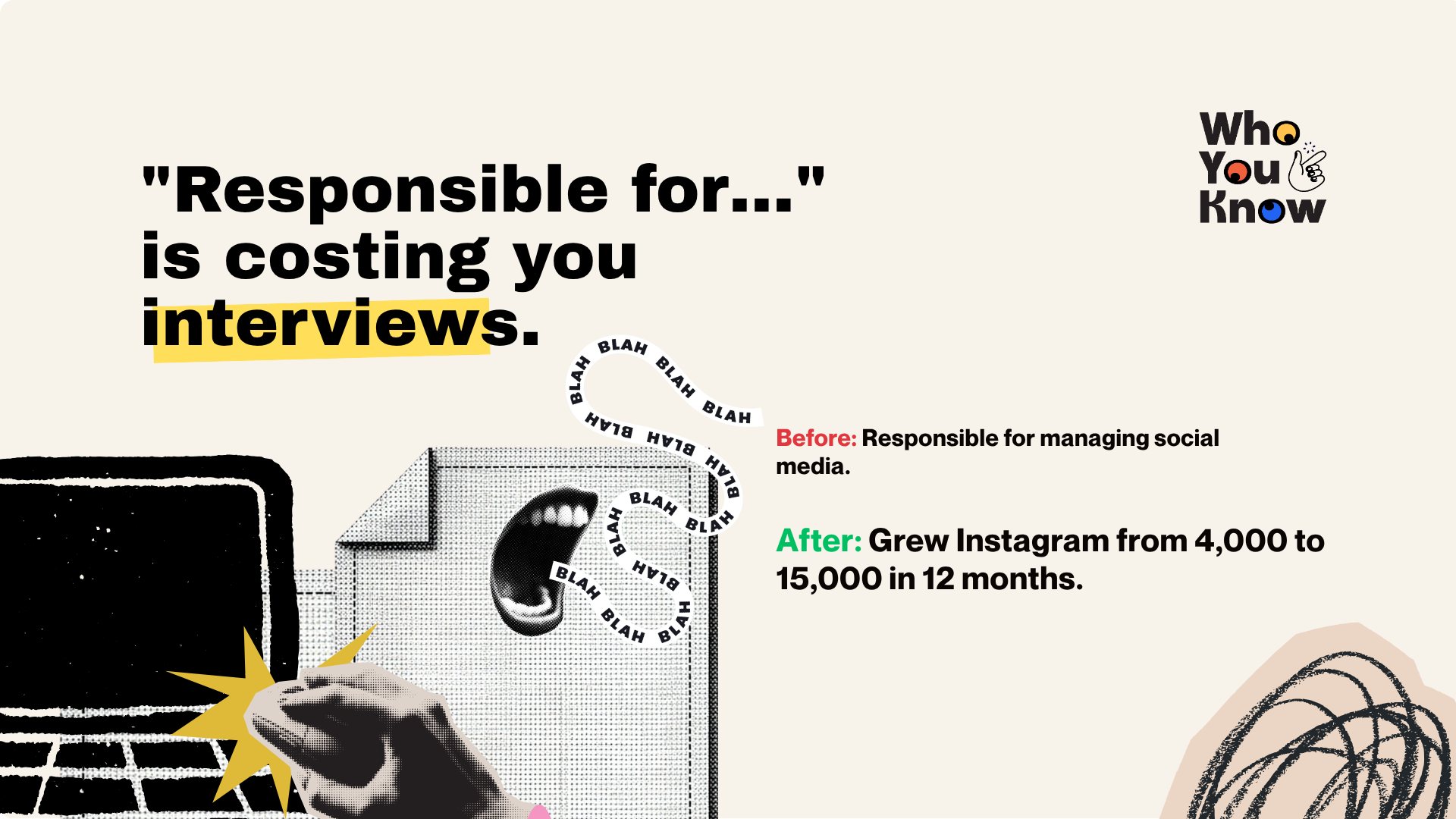
"Responsible for…" is costing you interviews
Open your CV. Scroll to your current job. Read the first bullet point.
Does it start like this?
Responsible for managing social media channels.
Yep. Most do. And look, it's not wrong. It's just telling the reader the least interesting thing about you.
"Responsible for" describes the job. It's basically your position description, copied and pasted. Anyone who's ever held that role could write the exact same line. What it doesn't say is whether you were any good at it.
And that's the only thing the person reading your CV actually wants to know.
Duties vs results
Here's the thing. A hiring manager already has a pretty good idea what a marketing coordinator or a data analyst does all day. You don't need to explain the job to them.
What they can't guess is what happened because you were there. Did things get faster? Bigger? Cheaper? Fixed? Did customers stick around? Did your team ship something that mattered?
A duty says what you were supposed to do. A result says what you actually did. One of those gets a shortlist. The other gets skimmed.
The bullet formula
Here's a structure that works for almost any role:
[Action verb] + [what you did] + [result or scale]
- Action verb: start strong. Built, launched, cut, grew, led, redesigned, automated, negotiated. Not "helped with" or "was involved in".
- What you did: the actual work, in plain words a stranger would understand.
- Result or scale: the "so what". A number if you've got one. If you don't, the scale (how many people, how big the budget, how many sites) or the outcome (what changed afterwards).
You won't nail all three every time. That's fine. Even going from duty to action plus outcome is a massive upgrade.
Five bullet mistakes we see all the time
1. "Responsible for…" The big one. Swap it for what you actually did while you were responsible.
2. "Assisted with" and "helped to". Undersells you every time. If you did part of it, say which part. "Wrote the onboarding emails for the product launch" beats "assisted with product launch".
3. The wall of tasks. Eight bullets, all equal weight, all duties. The reader can't tell what mattered. Put your best result first and cut anything that doesn't earn its spot.
4. Numbers without meaning. "Managed 47 tickets." Per day? Per year? Was that good? Give the number some context or leave it out.
5. Jargon from your old job. Internal project names, team acronyms, tools nobody outside your company has heard of. If a recruiter at another company wouldn't get it, rewrite it.
Before and after
Software engineer
- Before: Responsible for maintaining backend services.
- After: Rebuilt the order-processing service in Go, cutting average checkout response time from 900ms to 250ms.
Marketer
- Before: Responsible for managing social media channels.
- After: Grew Instagram following from 4,000 to 15,000 in 12 months by shifting to short-form video and weekly customer stories.
Data analyst
- Before: Created reports for the sales team.
- After: Built a Power BI dashboard that replaced six manual spreadsheets, saving the sales team around five hours a week.
Customer success
- Before: Handled customer queries and account management.
- After: Managed a portfolio of 60 mid-sized accounts and ran quarterly reviews that helped lift renewals across the book.
Operations
- Before: Assisted with warehouse processes.
- After: Redesigned the pick-and-pack workflow across two sites, reducing order errors and clearing a two-week backlog in a month.
Graduate
- Before: Completed a group project as part of my degree.
- After: Led a four-person team to design a booking app prototype for a local council, presented to council staff as the final assessment.
See what happened? Every "after" starts with a verb, says what the work actually was, and ends with something that changed. None of them explain the job. All of them explain the person.
Notice the grad one, too. No work experience needed. University projects, casual jobs, volunteering and side projects all count if you write them this way.
(One golden rule: these examples are illustrative, and the numbers are made up. Only use numbers on your CV that are true and that you're happy to talk through in detail. Someone will ask.)
"But I don't have any numbers"
Most people don't, at first. Try these prompts:
- Before and after: what was it like before you started, and after?
- Scale: how many customers, users, sites, stakeholders or dollars were involved?
- Time: did something get faster, or get done by a deadline that mattered?
- Firsts: were you the first to do it, or did you set up something that's still used?
- Recognition: did a manager, client or customer call it out?
A rough, honest estimate ("around five hours a week") is fine if you can explain how you got there. A made-up one isn't.
Fix yours in fifteen minutes
- Pick your last two roles. That's where readers look hardest.
- Highlight every bullet starting with "responsible for", "assisted" or "helped". Those are your rewrites.
- Run each through the formula. Verb, what, result.
- Reorder. Best result at the top of each role.
- Cut. Four to six strong bullets per recent role beats ten weak ones.
Then read it like you're the hiring manager. Would you want to chat to this person? No? Sharpen the results.
Bonus: your bullets become your talking points
Here's the bit people forget. Every good bullet is a story you can tell. When you're on a call with someone at a company you'd love to join, those results are what you'll actually talk about.
That's why we rewrite your CV bullets early in Who You Know Concierge, alongside your LinkedIn, before we line up calls with insiders at the companies you're targeting. Want a hand with yours? Check out Concierge.
Keep reading

Inside Concierge: what 5 weeks with a job hunt coach looks like
Over the last ten days on this blog, we've talked about fixing your LinkedIn headline, running your job search like a five-week project, and translating your…

New to Australia or changing careers? How to make your experience make sense to local hiring teams
You've got years of solid experience. You've led teams, shipped projects, hit targets. And yet the applications go out and not much comes back.