
New to Australia or changing careers? How to make your experience make sense to local hiring teams

You've got years of solid experience. You've led teams, shipped projects, hit targets. And yet the applications go out and not much comes back.
Here's a common reason: the hiring team doesn't doubt your experience. They just don't understand it.
Your job title means something different here. They've never heard of your last employer. Your biggest win is described in words that only make sense in your old industry. So instead of reading your CV and thinking "yes", they think "hmm, not sure", and move on to the next one.
The good news? This is a translation problem, and translation problems are fixable.
Use local job titles (without making things up)
Job titles vary wildly between countries and industries. An "Officer" in one place is a junior role; in another, it's a manager. A "Consultant" at one company is an account manager at the next.
Look at 10 or so Australian job ads for the role you want. What do they call it? Use that language, honestly. A simple trick is to keep your official title and add a plain-English version:
Project Lead (equivalent to Senior Project Manager)
Never claim a title you didn't hold. But you're allowed to help the reader understand what it meant.
Swap in the terms people use here
Every market has its own vocabulary. Australian ads might say "stakeholder management" where you'd have said "client liaison", or "BAU" where you'd have said "operations". Changing industries? Retail's "shrinkage" and finance's "loss" are cousins, but a hiring manager won't make that leap for you.
Go back to those job ads and highlight the phrases that keep coming up. Where they honestly describe what you did, use them. It helps a human reader, and it helps any system that's scanning for keywords too.
Explain employers people might not know
"Senior Analyst, Company Z" means nothing if nobody's heard of Company Z. Add one short line underneath that gives context:
Company Z: one of the largest logistics providers in Southeast Asia, around 3,000 staff across six countries.
Size, industry and reputation are what the reader needs. Keep it to one line and make sure every fact is true. That's it. Suddenly your experience has a frame around it.
Lead with results that travel
Some things mean the same everywhere. Money saved. Time saved. Customers served. Teams led. Projects delivered on time.
Your old company's internal awards or systems might not travel, but results do. So instead of:
Managed the Q-Flow rollout for APAC region
try:
Led the rollout of a new booking system across four countries, cutting customer wait times by half
(Only use numbers that are true and that you're happy to talk about. Someone will ask.)
If you're changing careers, this matters even more. A teacher moving into learning design has years of planning content, presenting and managing tricky audiences. A hospitality manager moving into operations has rostering, budgets and customer complaints down pat. Name the skill, then prove it with a result.
Add a short local-context line
Hiring teams often have a quiet question in the back of their mind: "Where is this person, and can they start?" Answer it before they have to ask.
Add one line near the top of your CV and in your LinkedIn About section:
Based in Melbourne since 2025. Background in civil engineering across road and rail projects in India and the UAE.
For career changers, it might be:
Moving from classroom teaching into learning design, bringing eight years of curriculum planning and delivery.
If work rights are relevant to the roles you're applying for, state them clearly and simply. Don't guess or assume. Check the details on official sources such as the Department of Home Affairs website, and get proper advice if you're unsure. We're not the people to ask about visas, and neither is a blog post.
Build a local network, one conversation at a time
Here's the hard truth: a lot of your old network doesn't reach into Australian companies, or into your new industry. So you need to build a new one. That sounds daunting, but it's really just a series of small, friendly conversations.
Start with:
- People who've made the same move. Others from your home country, or people who've switched from your old industry. They've solved the exact problem you're facing.
- Industry groups and meetups. Professional associations, local events, online communities for your field.
- Former colleagues who are already here. Worth a quick message, even if you haven't spoken in years.
Ask for informational calls
An informational call is a short chat, 15 to 20 minutes, with someone who works in the kind of role or company you're targeting. You're not asking for a job. You're asking to learn.
Good questions to ask:
- "How would you describe my background to someone in your team?"
- "What do hiring managers here look for that I might be missing?"
- "Which words or titles should I be using on my CV?"
That first question is gold. Hearing how a local insider translates your experience is the fastest way to fix your own story. And people are often more generous with their time than you'd expect, especially if you keep it short and say thanks.
Put it together
Before you send your next application, check your CV and LinkedIn against this list:
- Titles a local hiring manager would understand
- Terms that match Australian job ads
- One line of context for every lesser-known employer
- Results that make sense anywhere
- A clear local-context line near the top
Then go and have a few conversations. Your experience is valuable. It just needs a good translator.
If you'd like help with the translating, and with getting in front of people at the companies you're targeting, that's what Who You Know Concierge does. Check out Concierge.
Keep reading

Inside Concierge: what 5 weeks with a job hunt coach looks like
Over the last ten days on this blog, we've talked about fixing your LinkedIn headline, running your job search like a five-week project, and translating your…
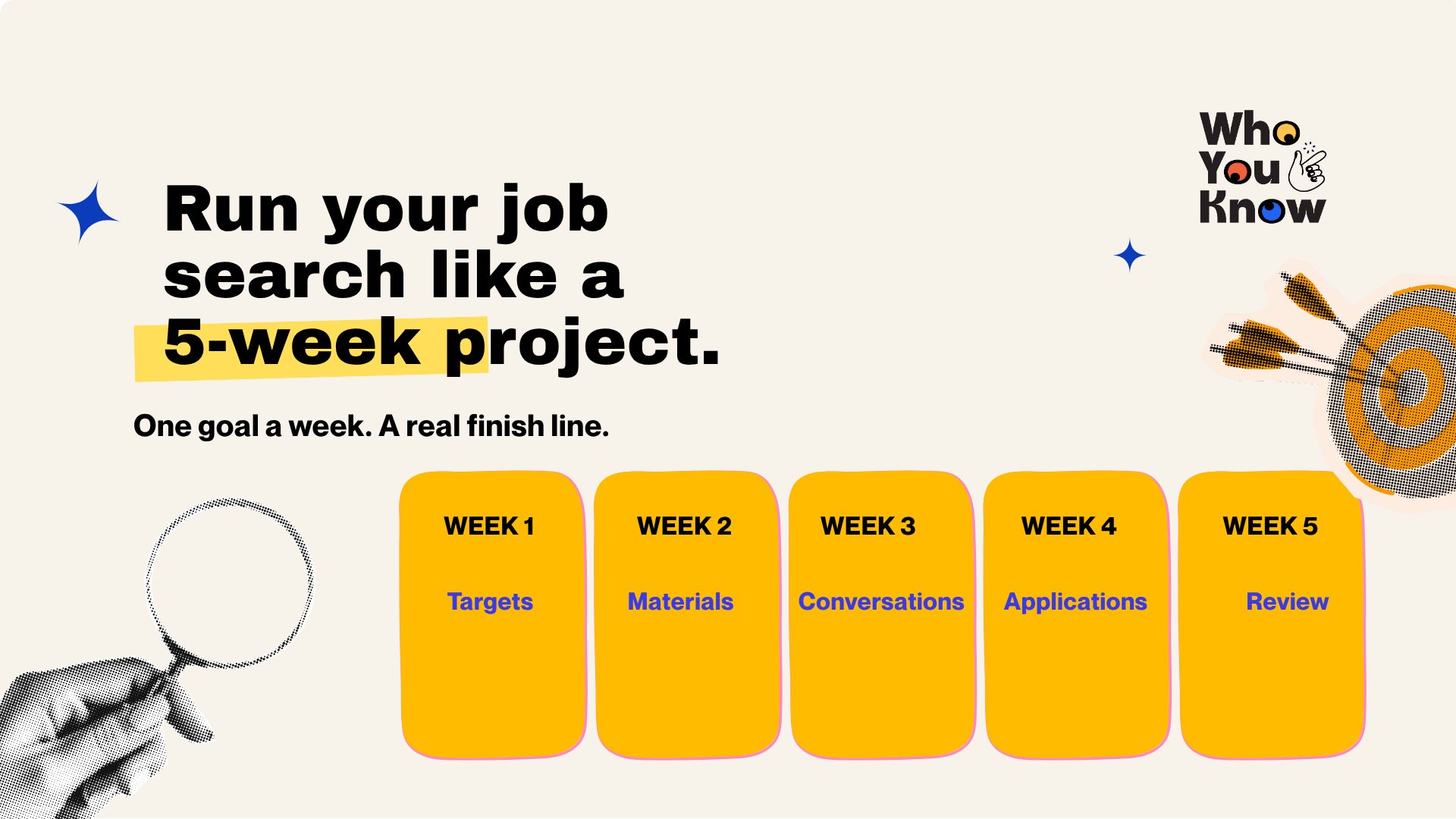
Run your job search like a 5-week project
Here's how most job searches go. You update your CV on a Sunday night. You fire off a few applications. You refresh your inbox. You fire off a few more. Three…