
Run your job search like a 5-week project
Here's how most job searches go. You update your CV on a Sunday night. You fire off a few applications. You refresh your inbox. You fire off a few more. Three months later you're tired, a bit flat, and not totally sure what you've actually done.
Sound familiar? It's not you. It's the lack of a plan.
At work, you'd never run a project with no deadline, no milestones and no check-ins. So why run your job search that way? Give it a shape, a start and an end, and it gets a lot less draining. And a lot more effective.
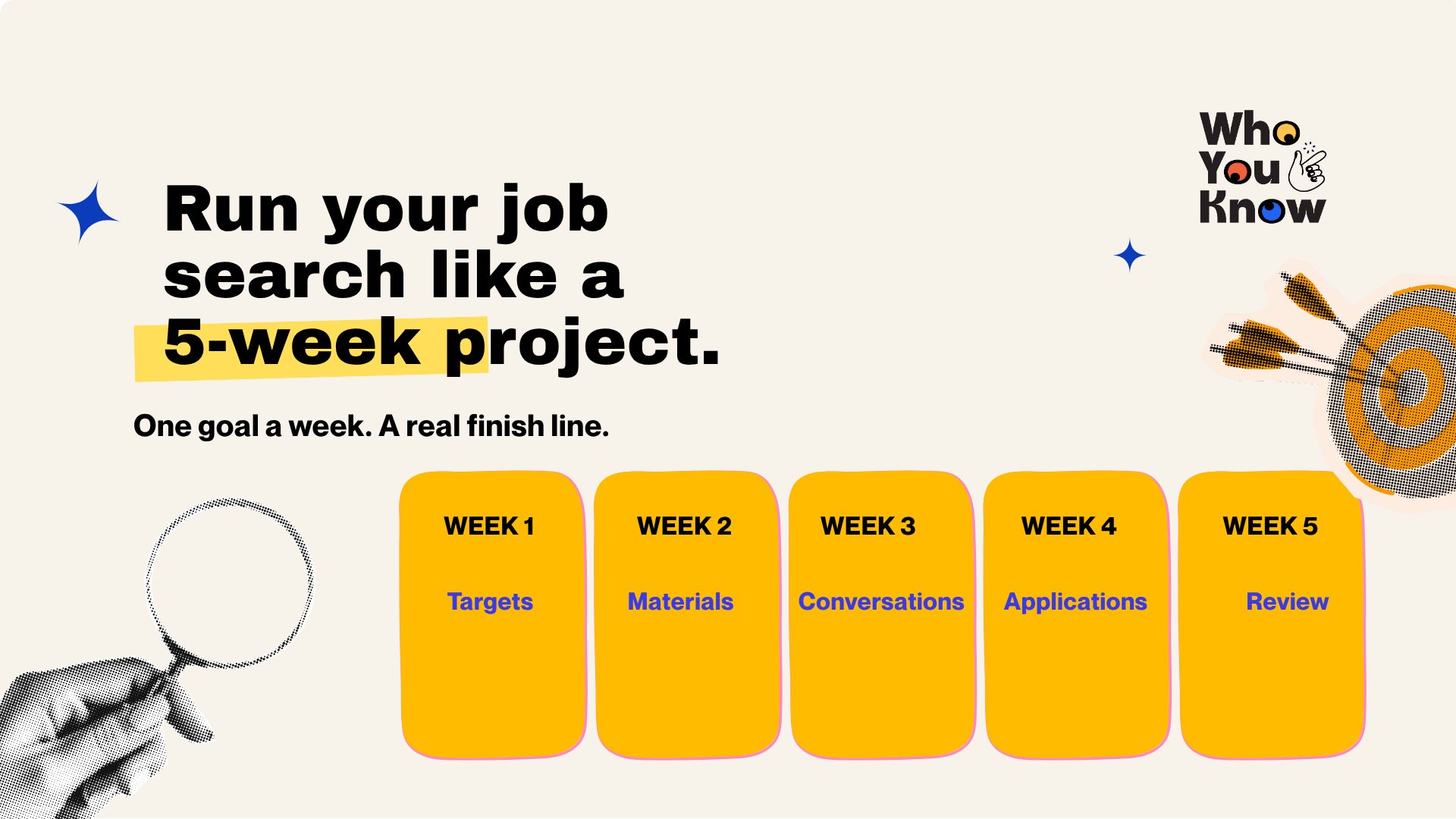
Here's a five-week structure that works for most people.
Why five weeks?
Five weeks is long enough to do things properly: work out what you want, fix your materials, have real conversations and apply with intent. It's short enough that you can see the finish line from the start.
It's not a promise that you'll have a job at the end of week 5. Hiring timelines are mostly out of your hands. But it is a promise to yourself that you'll have done the work, learned what's working, and know exactly what to do next.
Week 1: pick your targets and your pitch
Most people skip this bit and go straight to applying. Don't.
This week is about deciding where you're aiming:
- Two or three target roles. Be specific. "Something in marketing" isn't a target. "Content marketing manager at a B2B software company" is.
- A shortlist of 15–25 companies you'd genuinely like to work for. Look at who's hiring, sure, but also who you admire, who's growing, and who does work you care about.
- Your positioning. In one or two sentences, what are you great at and what proof do you have? This becomes your LinkedIn headline, the top of your CV and the way you introduce yourself.
Week 1 goal: a written list of target roles, target companies and your one-line pitch.
Week 2: sharpen your CV and LinkedIn, and start reaching out
Now you know what you're aiming at, make your materials point the same way.
- Tailor your CV to your target roles. Lead with the results that matter for those jobs, and cut what doesn't.
- Update your LinkedIn so it tells the same story: headline, About section, a decent photo, and recent roles that match your CV.
- Start your first outreach. Pick five people at your target companies (someone in the team you'd join, or a similar role) and send a short, friendly message asking for a quick chat about what it's like there.
Keep outreach messages short. Say who you are, why them, and what you're asking for. Something like: "Hi Sam, I'm a product designer looking at health tech, and your team's work caught my eye. Would you be up for a 15-minute chat about what it's like working there?"
Week 2 goal: CV and LinkedIn updated, and at least five outreach messages sent.
Weeks 3–4: conversations and applications
This is the engine room. Two weeks of steady, focused activity.
- Have the conversations. Treat them as research, not a job interview. Ask about the team, the challenges, and what makes someone good in the role. Don't open with "can you refer me?". If the chat goes well, it often comes up naturally.
- Keep reaching out. A few new messages every week keeps the pipeline moving. Not everyone will reply, and that's normal.
- Apply with intent. Fewer, better applications beat a spray-and-pray approach. For each one, tailor your CV and, where you can, mention something you learned from a conversation.
- Follow up. A polite nudge a week after applying or messaging is fine. Once is enough.
Weeks 3–4 goal: set a number that suits you, for example three conversations and five tailored applications each week. The point is a steady rhythm, not a heroic sprint.
Week 5: review and plan what's next
Stop and look at what happened. Honestly.
- What got replies? Which messages, roles or companies responded? Do more of that.
- What went quiet? If applications to one type of role got nothing, is it the role, the CV, or the way in?
- What did you learn? Did a conversation change your mind about a target? That's a win, not a setback.
Then decide on your next block. Maybe you keep going with sharper targets. Maybe you narrow down. Maybe you're in interviews and need to prep. Either way, you're choosing, not drifting.
Week 5 goal: a one-page review and a clear plan for the next few weeks.
Keep a simple tracker
You don't need fancy software. A spreadsheet with these columns does the job:
| Company | Role | Contact | What you did | Date | Next step | Follow-up date |
|---|
Every time you message someone, apply or have a chat, add a row. It takes 30 seconds, and it means you'll never lose track of who you spoke to or forget to follow up. It also makes your week 5 review about ten times easier.
Don't burn out
A job search can quietly take over your whole life if you let it. A few ground rules help:
- Set working hours for it. Even an hour a day, at the same time, beats checking your inbox at 11pm.
- Measure what you control. You control messages sent and applications submitted. You don't control who replies. Judge your week on the first bit.
- Take a day off. Seriously. The job ads will still be there on Monday.
- Celebrate small wins. A reply, a good chat, a sharper CV. They all count.
Why a weekly check-in changes everything
Here's the thing most people are missing: someone to answer to.
Left alone, it's easy to let a week slide. "I'll do outreach next week" turns into a month. A weekly check-in with someone, a friend, a mentor, a former manager, fixes that. Once a week, you tell them three things: what you did, what happened, and your one goal for next week.
It works because saying your goal out loud to another person makes it real. And a good check-in partner will give you honest feedback when something isn't landing, which is hard to spot from the inside.
That's exactly how our Who You Know Concierge program is built: five weeks, a clear plan, weekly check-ins, and intro calls with insiders at the companies you're targeting. Want someone in your corner for the whole thing? Check out Concierge.
Keep reading

Inside Concierge: what 5 weeks with a job hunt coach looks like
Over the last ten days on this blog, we've talked about fixing your LinkedIn headline, running your job search like a five-week project, and translating your…

New to Australia or changing careers? How to make your experience make sense to local hiring teams
You've got years of solid experience. You've led teams, shipped projects, hit targets. And yet the applications go out and not much comes back.