
One CV, five companies: how to tailor without starting from scratch

Everyone says you should tailor your CV for every job.
And everyone who's actually applied for jobs knows how that goes. You open the doc, start fiddling, and two hours later you've rewritten your whole career history for one role. Then you do it again tomorrow. By the fifth application, you're sending the same version to everyone and hoping for the best.
Look, the advice is right. A CV that speaks directly to the role stands out. But the way most people do it is wrong.
You don't need five CVs. You need one really good one, and a system for tweaking it in twenty minutes.
Step 1: build a master CV
This is the big one. Your master CV is not the thing you send. It's your private library.
Put everything in it:
- Every role, with every decent bullet point you've ever written
- Several versions of your summary, each angled at a different kind of role
- All your skills, tools, qualifications and certifications
- Side projects, volunteering, awards, anything you might use one day
It'll be long. That's the point. When it's time to apply, you're not writing from scratch. You're choosing.
(While you're at it, make sure your bullets are results, not duties. Our guide to CV bullets covers that.)
Step 2: read the job ad properly
Most people skim the job ad. Don't. Spend five minutes on it with a highlighter (real or digital) and pull out three things:
- The top three priorities. What do they mention first, most often, or with the most words? That's what they care about.
- The exact words they use. Do they say "stakeholder management" or "working with senior leaders"? "Customer success" or "account management"? Note them down.
- The problem behind the role. Why does this job exist? Are they scaling, fixing something, launching something new? Read between the lines.
Then look at the company itself. Their careers page, recent news, what their people post on LinkedIn. It'll tell you a lot about what "good" looks like there.
Step 3: swap the summary
Your summary (the two or three lines at the top) is the fastest, highest-impact change you can make.
Pick the closest version from your master CV and adjust it so it mirrors the role. Same job title they're hiring for, same priorities, same language.
Illustrative example, same person, two roles:
- For a growth marketing role at a startup: Growth marketer with five years in email and paid social, focused on experiments that move sign-ups and retention.
- For a brand role at a large retailer: Marketer with five years across brand, content and email, known for campaigns that keep customers coming back.
Same experience. Different emphasis. Both true.
Step 4: reorder and swap your top bullets
Readers look hardest at the top of your most recent role. So that's where your most relevant results need to be.
For each application:
- Move the bullets that match their top priorities to the top of each recent role.
- Swap in bullets from your master CV that fit this role better than your usual ones.
- Cut the ones that don't help. Relevant beats comprehensive.
You're not changing what you did. You're changing what the reader sees first.
Step 5: use their keywords (honestly)
Lots of companies use applicant tracking systems to sort and search CVs, and plenty of recruiters search for specific terms. So using the same words as the job ad genuinely helps.
If they say "Salesforce" and you've used Salesforce, make sure it says "Salesforce", not "CRM". If they say "project management" and you've run projects, use those words.
But only for things you've actually done. Stuffing in skills you don't have might get you through a filter, and then you'll be asked about them. Not a fun conversation.
What not to change
Tailoring has limits. Keep these the same across every version:
- Job titles, employers and dates. Never tweak these. They get checked.
- Your results and numbers. Choose which ones to show, but don't inflate them for a particular role. Only use numbers that are true and that you can talk about.
- Your formatting. One clean, simple layout. Don't redesign for each company.
- Your contact details and LinkedIn link. And make sure your LinkedIn tells the same story.
The twenty-minute routine
- Read the job ad and note the top three priorities and keywords. (5 min)
- Pick and tweak a summary from your master CV. (5 min)
- Reorder and swap bullets in your two most recent roles. (5 min)
- Check keywords and cut anything irrelevant. (3 min)
- Save it with a clear name like YourName_CV_CompanyName.pdf, and read it once as the hiring manager. (2 min)
Do this five times and you'll have five sharp, tailored CVs, without starting from scratch once.
Bonus: tailoring works better with inside knowledge
The best tailoring comes from knowing what the team actually needs. And the job ad only tells you part of that. A quick chat with someone who works there tells you the rest: what they really value, what the role is solving, which words matter.
That's how Who You Know Concierge works. We build your master CV and LinkedIn with you, then line up calls with insiders at the companies you're targeting, so you know exactly what to tailor. Want a hand? Check out Concierge.
Keep reading

Inside Concierge: what 5 weeks with a job hunt coach looks like
Over the last ten days on this blog, we've talked about fixing your LinkedIn headline, running your job search like a five-week project, and translating your…
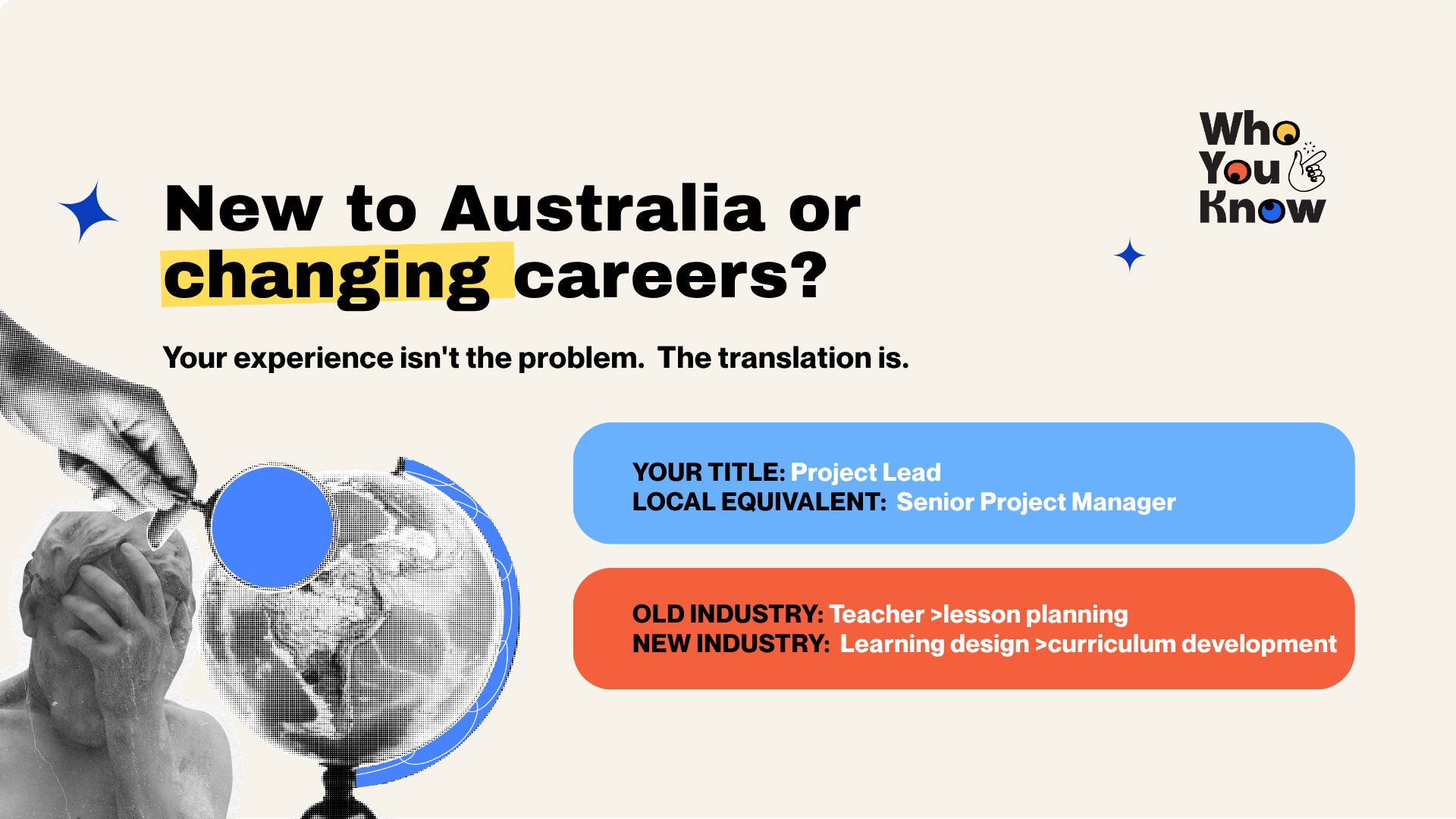
New to Australia or changing careers? How to make your experience make sense to local hiring teams
You've got years of solid experience. You've led teams, shipped projects, hit targets. And yet the applications go out and not much comes back.